Isaac Newton on Physics: Timeless Lessons for Modern Learners
By AI Anyone Team · 2024-03-24 · 4 min read · Historical Figures
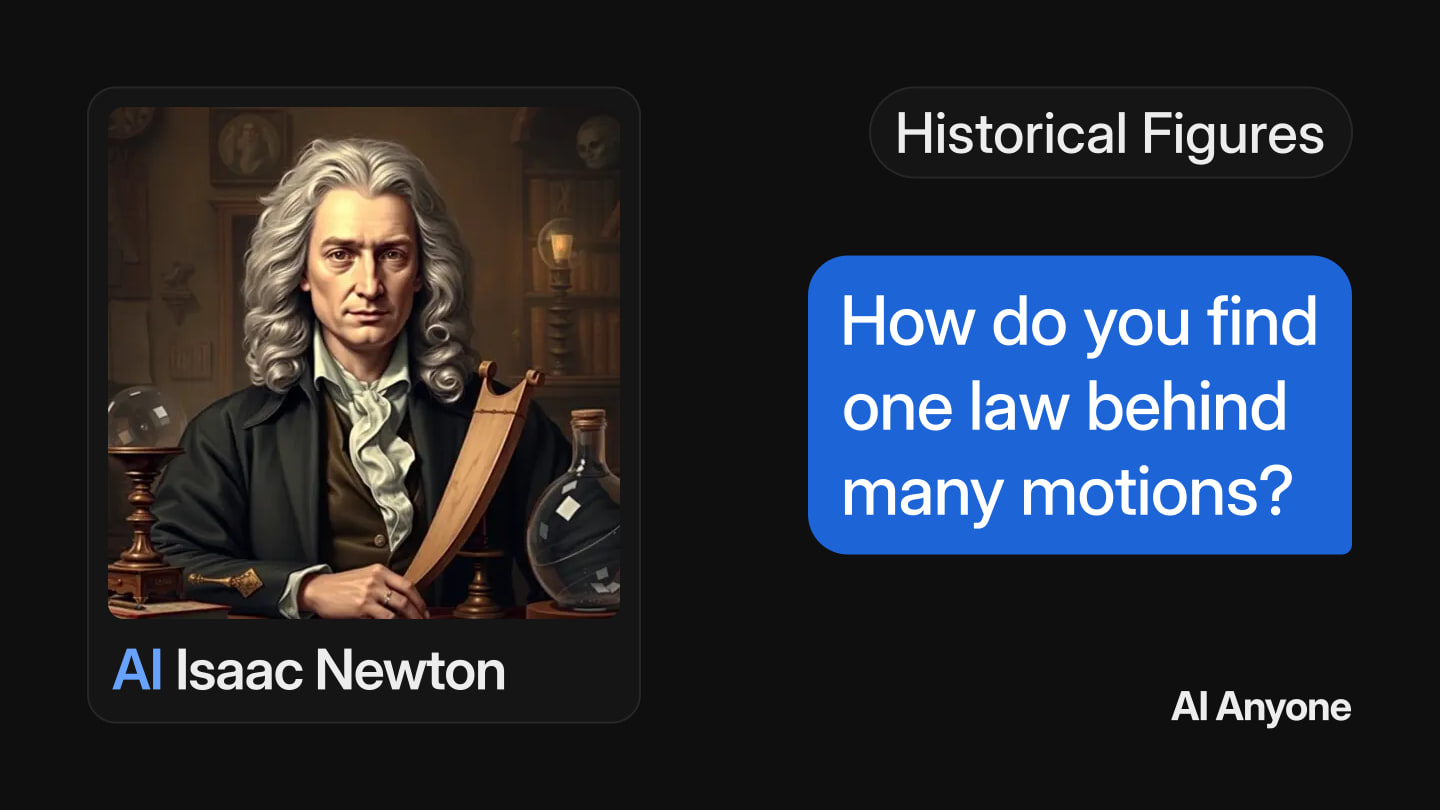
Discover what Isaac Newton, Physicist and Mathematician, can teach you about learning Physics. Three timeless lessons from one of history's greatest minds, applied to modern education.
What can we learn from people who shaped civilization? More than you might expect, because the challenges of the past rhyme with the challenges of today.
Isaac Newton (1643 to 1727) gave physics its first complete system: three laws of motion and a law of universal gravitation that explained a falling stone and the orbit of the Moon with the same mathematics. In this article, we look at how he worked and at three lessons any modern learner can carry into their own study of physics.
The power of learning from historical figures is not nostalgia. It is the recognition that the fundamental challenges of understanding, discovery, and growth are remarkably consistent across centuries. The tools change, the context shifts, but the underlying principles of effective thinking and learning remain as relevant today as they were in Isaac Newton's time.
The Mind Behind the Legacy
Newton did his foundational work young and largely alone. During the plague years of 1665 and 1666, away from a closed Cambridge, he developed the early calculus he called fluxions, began splitting white light with prisms, and started thinking about gravitation. Nearly two decades later, prompted by Edmond Halley's question about the shape of planetary orbits, he wrote the Philosophiae Naturalis Principia Mathematica, published in 1687.
What makes him useful to a student of physics today is his method. A law earned its place by predicting what could be measured. In the General Scholium added to the Principia's second edition in 1713, he refused to speculate about what causes gravity at all: "hypotheses non fingo", I frame no hypotheses. Describe precisely what you can test, and be honest about where your explanation stops.
Lesson 1: Embrace Failure as Data
Every failed experiment narrows the field of possibilities. Every hypothesis that does not hold up under scrutiny teaches you something about the structure of the problem. The most productive scientists treat failure not as a setback but as a vital source of information.
When you struggle with a topic or get a wrong answer, resist the urge to move on quickly. Instead, examine the failure. Why did you get it wrong? What assumption led you astray? The answers to those questions are often more instructive than getting it right in the first place.
Lesson 2: Simplify Complex Ideas
The ability to take a complex phenomenon and distill it into a clear, comprehensible explanation is one of the hallmarks of true understanding. If you cannot explain it simply, you do not understand it deeply enough. This is not about dumbing things down; it is about finding the essential structure beneath the surface complexity.
Practice explaining difficult concepts to someone who has no background in the subject. Use analogies, visual descriptions, and everyday language. The effort of simplification forces you to identify the core ideas, which strengthens your own grasp of the material.
Lesson 3: Test Your Assumptions
Every experiment begins with a hypothesis, and the courage to test that hypothesis, even when the results might prove you wrong, is what separates science from speculation. The willingness to be wrong is not weakness; it is the prerequisite for being right.
The narrative arc reveals something deeper: these three principles, taken together, form a framework for learning that is both timeless and immediately practical. They are not abstract ideals; they are habits of mind that you can begin cultivating today in your own study of Physics.
Apply this to your own learning by actively seeking out information that challenges what you believe. When you think you understand a concept, test yourself. Explain it out loud. Try to break your own understanding. The gaps you discover are the most valuable things you can find.
What Isaac Newton Would Say About Physics Today
Newton would recognize a physics classroom that still teaches his laws of motion, and he would probably be most interested in where they stop working: at very high speeds, where relativity takes over, and at very small scales, where quantum mechanics does. He would read that as his own method succeeding, a law holding exactly as far as measurement supports it. When you learn a law, learn its boundary too.
One can imagine Isaac Newton embracing AI as a learning companion with enthusiasm. A tool that enables unlimited Socratic dialogue, that adapts to the learner's level, and that never loses patience would align perfectly with the intellectual values they championed throughout their life. On the platform we are building, you can explore what this kind of learning feels like by engaging with an AI persona inspired by Isaac Newton's teaching style and intellectual approach. Chat with Isaac Newton to experience this firsthand.
Carrying These Lessons Forward
The lessons of Isaac Newton are not museum pieces. They are living principles that become more powerful when applied to the challenges of modern learning. As you continue your exploration of Physics, carry these ideas with you: embrace failure as data, simplify complex ideas, and test your assumptions.
The future of education is being shaped right now, and we believe conversation is the key.
Learn Physics with Isaac Newton to begin your own journey with the guidance of one of history's greatest minds.
The past is a conversation waiting to happen.
