Aristotle on Personal Finance: Timeless Lessons for Modern Learners
By AI Anyone Team · 2024-10-26 · 4 min read · Historical Figures
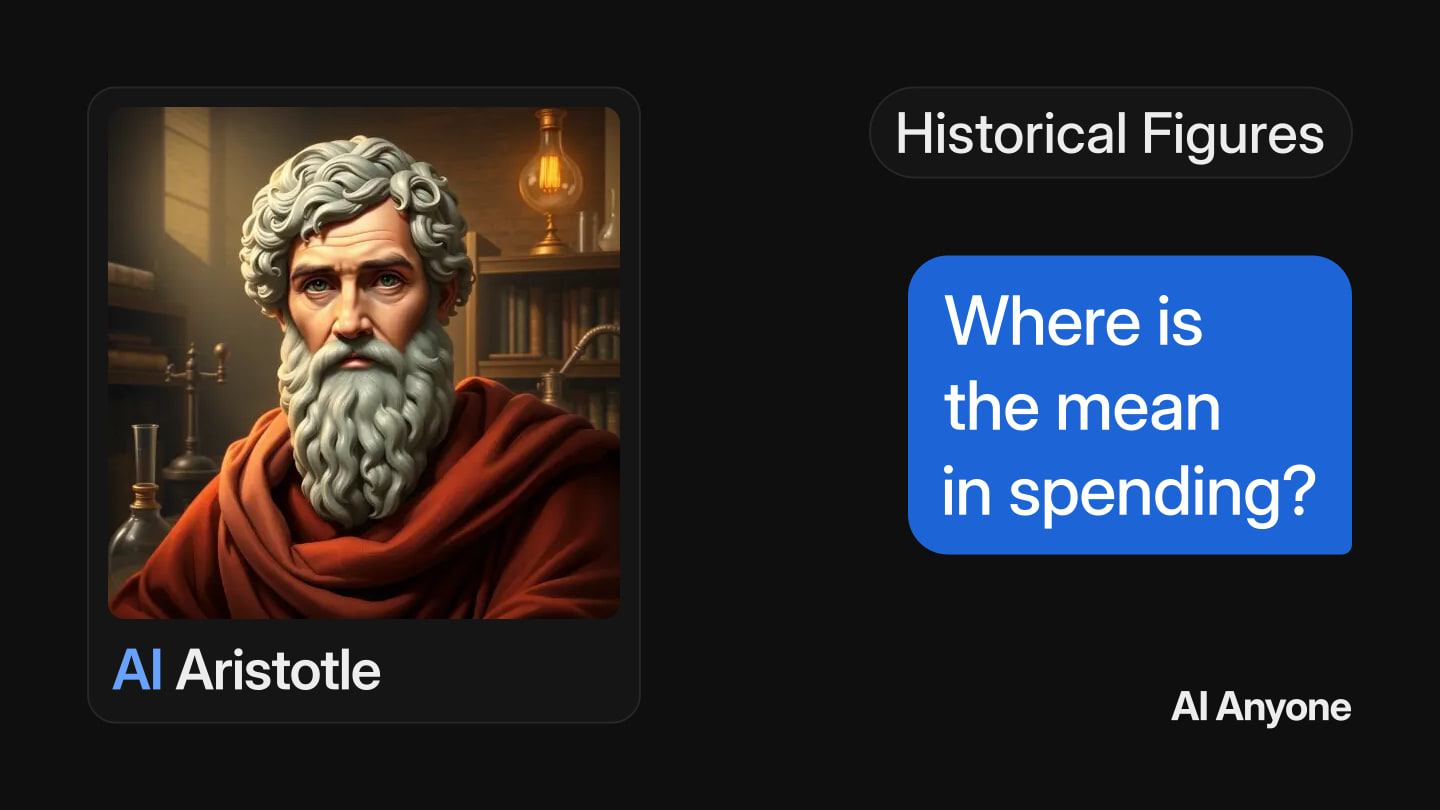
Discover what Aristotle, Philosopher and Polymath, can teach you about learning Personal Finance. Three timeless lessons from one of history's greatest minds, applied to modern education.
Behind every major breakthrough in human history stands a person who refused to accept the limitations of their time.
Aristotle (384 to 322 BC) wrote about money more carefully than many modern finance books. In the Politics he separated running a household from the business of piling up money, and in the Nicomachean Ethics he treated spending well as a virtue in its own right. In this article, we look at how he thought and at three lessons any modern learner can carry into their own study of personal finance.
The power of learning from historical figures is not nostalgia. It is the recognition that the fundamental challenges of understanding, discovery, and growth are remarkably consistent across centuries. The tools change, the context shifts, but the underlying principles of effective thinking and learning remain as relevant today as they were in Aristotle's time.
The Mind Behind the Legacy
In Book I of the Politics, Aristotle distinguishes oikonomia, the management of a household, from chrematistike, the art of getting wealth. Household management has a natural limit: it aims at enough of what a good life needs. Making money for its own sake has no limit at all, and he warns that people who confuse the two end up treating accumulation as the goal instead of the means.
In Book IV of the Nicomachean Ethics he names the virtue that governs everyday spending: liberality, the mean between prodigality, which spends and gives too freely, and illiberality, which holds on too tightly. For a modern learner that is a practical frame. Budgeting and investing are tools, and the question Aristotle keeps asking is what they are for.
Lesson 1: Examine Your Beliefs
The unexamined life, as Socrates famously argued, is not worth living. This extends to the unexamined belief, the unexamined assumption, and the unexamined opinion. True wisdom begins when you turn your critical faculties inward and question the foundations of your own thinking.
Before studying any new subject, take stock of what you already believe about it. Write down your assumptions. As you learn, check those assumptions against the evidence. You will be surprised how often your starting beliefs were incomplete, outdated, or entirely wrong.
Lesson 2: Seek Wisdom, Not Just Knowledge
Knowledge is the accumulation of facts. Wisdom is the ability to apply those facts with judgment, context, and ethical awareness. The great philosophers understood that knowing a lot matters less than knowing what to do with what you know.
As you learn, consistently ask yourself how this knowledge applies to your life and the lives of others. What decisions does it inform? What responsibilities does it create? Connecting knowledge to action is what transforms information into genuine understanding.
Lesson 3: Dialogue Reveals Truth
The dialectical method, the practice of arriving at truth through structured conversation, remains one of the most powerful tools for learning ever devised. When two minds engage honestly with an idea, testing it from multiple angles, the result is almost always a deeper understanding than either could have reached alone.
This was not an isolated incident, these three principles, taken together, form a framework for learning that is both timeless and immediately practical. They are not abstract ideals; they are habits of mind that you can begin cultivating today in your own study of Personal Finance.
Engage in dialogue about what you are learning, whether with classmates, mentors, or AI tutors. Ask questions, entertain counterarguments, and revise your position when the evidence warrants it. Learning through conversation is not just effective; it is how the deepest thinkers in history did their best work.
What Aristotle Would Say About Personal Finance Today
Aristotle would find modern finance full of tools built to grow money without asking what the money is for. He would not reject them. He would ask where your enough is, and whether your plan serves it.
One can imagine Aristotle embracing AI as a learning companion with enthusiasm. A tool that enables unlimited Socratic dialogue, that adapts to the learner's level, and that never loses patience would align perfectly with the intellectual values they championed throughout their life. On a project we have been working on, you can explore what this kind of learning feels like by engaging with an AI persona inspired by Aristotle's teaching style and intellectual approach. Chat with Aristotle to experience this firsthand.
Carrying These Lessons Forward
The lessons of Aristotle are not museum pieces. They are living principles that become more powerful when applied to the challenges of modern learning. As you continue your exploration of Personal Finance, carry these ideas with you: examine your beliefs, seek wisdom, not just knowledge, and dialogue reveals truth.
We are building a new kind of learning platform that puts conversation at the center. Stay tuned.
Learn Personal Finance with Aristotle to begin your own journey with the guidance of one of history's greatest minds.
The past is a conversation waiting to happen.
